I mentioned in my last post that I’m in the first year of a three-year grant from the Davis Foundation to explore the design of emergent, flexible, and progressive education. I applied for this grant in the fall of 2024 when the budget situation at Plymouth State wasn’t great, but wasn’t horrifying. Since then, things have taken a turn towards horrifying.
The grant is centered around another professional project of mine, an open faculty development curriculum called Design Forward. I imagined Design Forward initially in the spring of 2021. As the University was contending with the ongoing challenges of Covid19, Robin and I looked around and decided we needed to develop the “next step” in our faculty development work in the CoLab. The pandemic had focused everyone on online learning, for better or for worse, and it seemed like this was an opportunity to design and promote alternative ways of thinking about online education, ways that aligned with the Cluster Learning approach that had been developing at PSU.
Design Forward has a core curriculum of five modules: Intro to Pedagogy, Care & Equity, Formats & Modalities, Tech & Tools, and Designing for Education. The modules are themselves organized around four “nodes”: topics, questions, resources, and activities. In addition, participants in Design Forward have an online portfolio in which they can share the work they’re doing in the modules. The curriculum is completely openly available and licensed; you can browse it at the Design Forward website to get a sense of what it entails. The only content that is behind a login is some participants’ contributions.
(Interestingly, while our initial intent for Design Forward was to create a resource for the support of online learning, since 2021, PSU (like many schools) has emphasized face-to-face classes. Rather than igniting interest in new ways of learning online, the pandemic seems to have had the opposite effect.)
In addition to the core modules, we have a few “flexible” modules in DF. These are meant to help us address specific institutional goals or emergent topics. For example, we have flexible modules that cover teaching two of our general education cornerstone classes, and we have one that covers the use of generative artificial intelligence for teaching and learning.
Over the last five years, Design Forward has become a labor of love for me. It’s allowed me to explore my own kind of emergent design. Modules in DF aren’t imagined as linear experiences. Instead, participants are encouraged to explore across all the nodes of a module, focusing on what most interests them and finding and making connections along the way.
While I work hard to still keep this loosely configured structure coherent, I know that some participants struggle with the approach (others find the flexibility refreshing). The fact is that it is easier and more comfortable to learn when someone prescribes a path for us. Our students often express this, and it can be a whole lot easier to design courses when we have prescribed paths we want our students to take. It’s satisfying to identify objectives and work backwards from those as we design tidy structures of learning to help students reach those objectives. But, even when we’ve done our best to build well-marked and clear paths, we all know that learning can “go astray.” Design Forward (and the work of the grant) is about learning to accept and embrace that “astray-ness” — and to consider how we design learning structures that make “going astray” a feature and not a bug.
I don’t know the best way to teach this way. I don’t know the best answers or models, practices or approaches. My goal with this grant was to work with my colleagues across PSU to try to unearth answers, models, practices, and approaches.
But, I’m not going to lie, overseeing a grant like this while the institution is in a period of great upheaval is really, really hard. Last week, our administration announced another round of incentivized retirements for faculty, and, perhaps, layoffs of some faculty and staff. At this point, more losses will mean drastically changing the face of our University, what programs we offer, what general education we provide, and how we serve our students. My work is so deeply embedded in these matters that it’s hard for me to know how to best serve my campus right now and going forward. It feels increasingly hard to convince faculty that this is work worth doing when their future at the University is unknown. I’m doing my best because that’s literally all I can do. But when I consider all the possibilities and potential that have already been lost — and a future that seems to promise more of the same — it’s beyond demoralizing. This isn’t where I expected to be at this point in my career, but I also know that colleagues at PSU and elsewhere are all feeling the same. What a terrible, terrible waste.
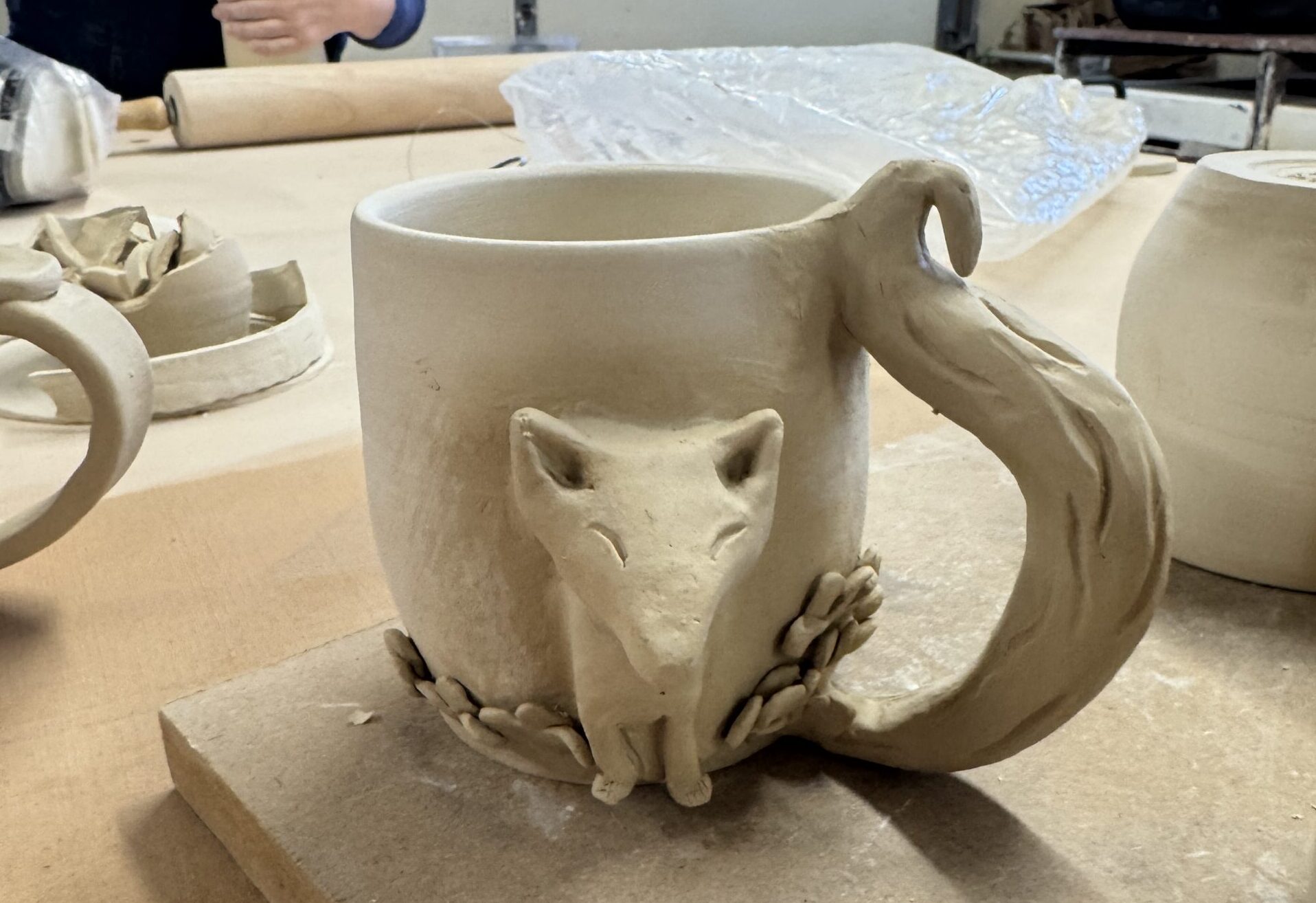
Image: This was a fox mug I threw and embellished. I waited too long to add the fox, and the whole thing cracked. It is now in a bag, waiting for me to reclaim the clay. There’s some kind of metaphor there. . .


Leave a Reply